Seed Pod
This series began with a vision.
Seed pods hanging from the ceiling.
Some pregnant, others bursted open, all turning slowly in the air.
After that image appeared, I began noticing them everywhere.
Mesquite pods splitting open along branches.
Oleander seeds drifting through the wind.
Down to the tiniest seeds of common weeds,
so small, and in such large quantities, it's hard for us to actually perceive.
Hundreds.
Thousands.
Millions.
The deeper pattern visible in nature is not scarcity.
It is abundance.
Seed Pod begins by turning attention back to the evidence of abundance unfolding all around us:
life reproducing itself again and again.
Seed Pod began with an installation vision rather than a painting.
The paintings emerged as a way to explore and understand the vision, and therefore they are not illustrations of specific pods. They are studies exploring their symbolism — abundance, multiplicity, the sensation of many elements existing at once.
This investigation is still unfolding. Three elements are emerging so far.

To begin understanding the installation more fully, I started experimenting with materials in the studio.
Early studies layer soil, seeds, and compost collected from my yard directly into the surface of the paintings. Fragments of eggshell, dried plant matter, and organic debris become embedded within textured grounds, then stabilized with paint, paper, and metal leaf — dense surfaces where multiple layers of life accumulate within a single image.
Later studies introduced silk fibers, a material that diffuses light differently than paint or leaf. Current experiments are exploring cast leaves embedded directly into the surface.
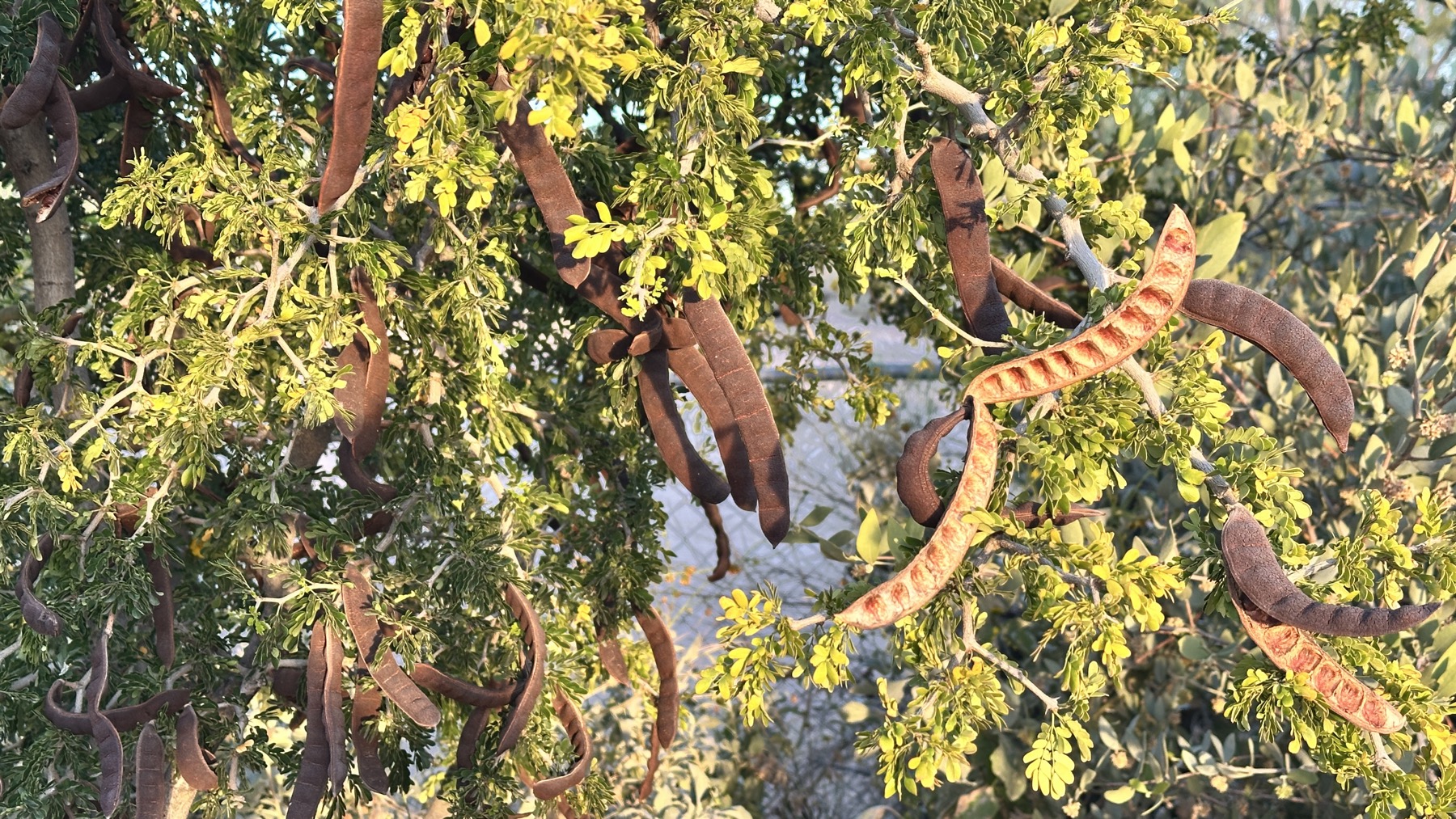
Seed systems embody one of nature's most generous gifts. A single plant produces thousands of seeds — millions of of potential generations to come.
Forms multiply across the surface rather than organizing around a single focal point. Patterns repeat. Textures accumulate. The image becomes less about depicting a single object and more about expressing the generative force behind it.
Abundance.
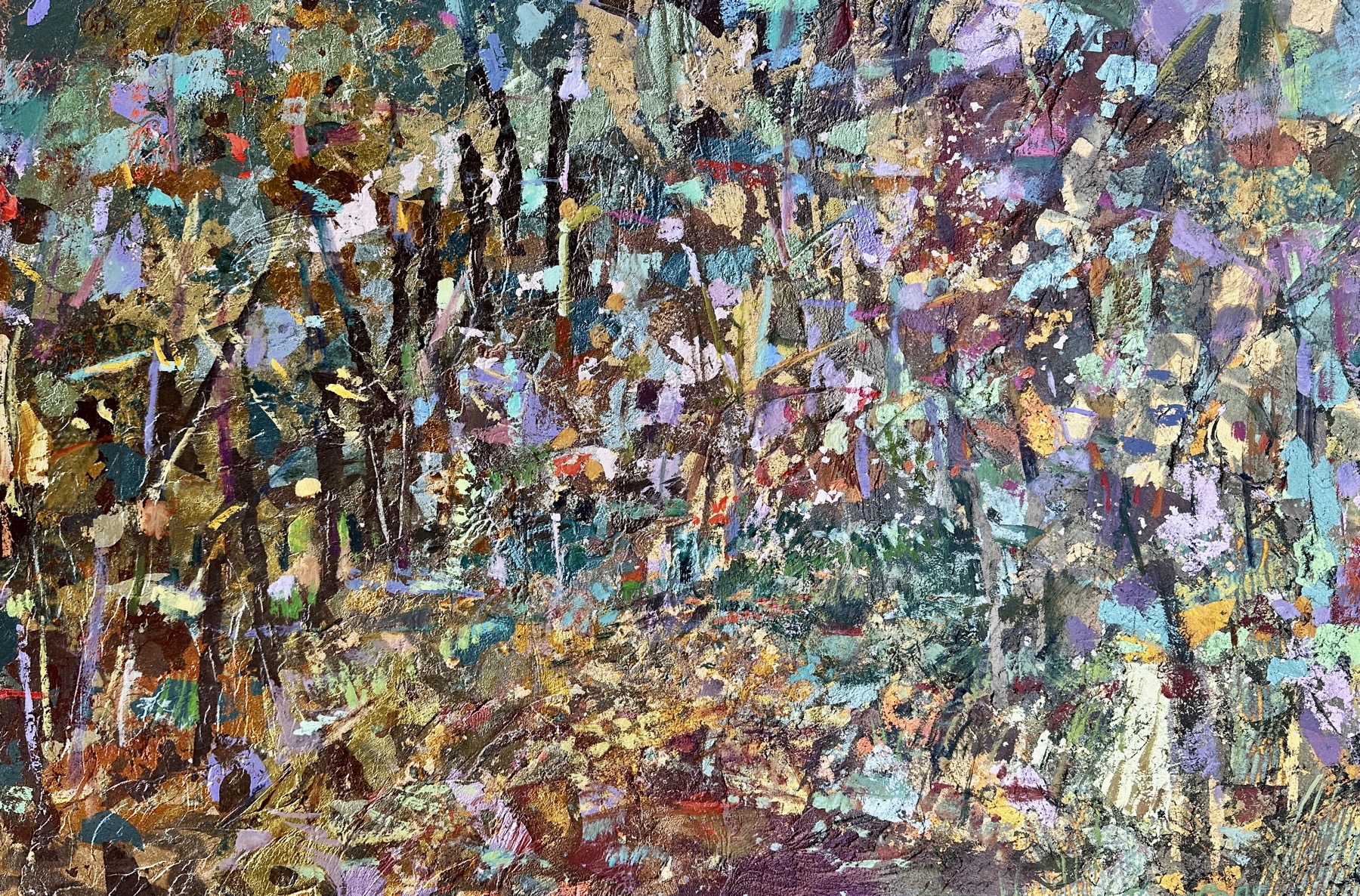
Standing in a landscape, the eye never rests on one thing for long. Focus moves constantly — from the whole plant, to the stem, to the leaf, to tiny seed, and back out again to the tree behind it, the sky behind that, to the entire landscape, all in an entire instant.
These paintings experiment with that experience of seeing. Instead of directing attention toward a single subject, the surface holds many elements simultaneously. Forms emerge, dissolve, and reshape, depending on how the viewer lets their eyes settle.
The result is not a fixed image but a shifting field of images— one that invites the eye to move through abundance rather than isolate a single object.
The investigation is beginning to take form through six works in the series.
Field of Trees
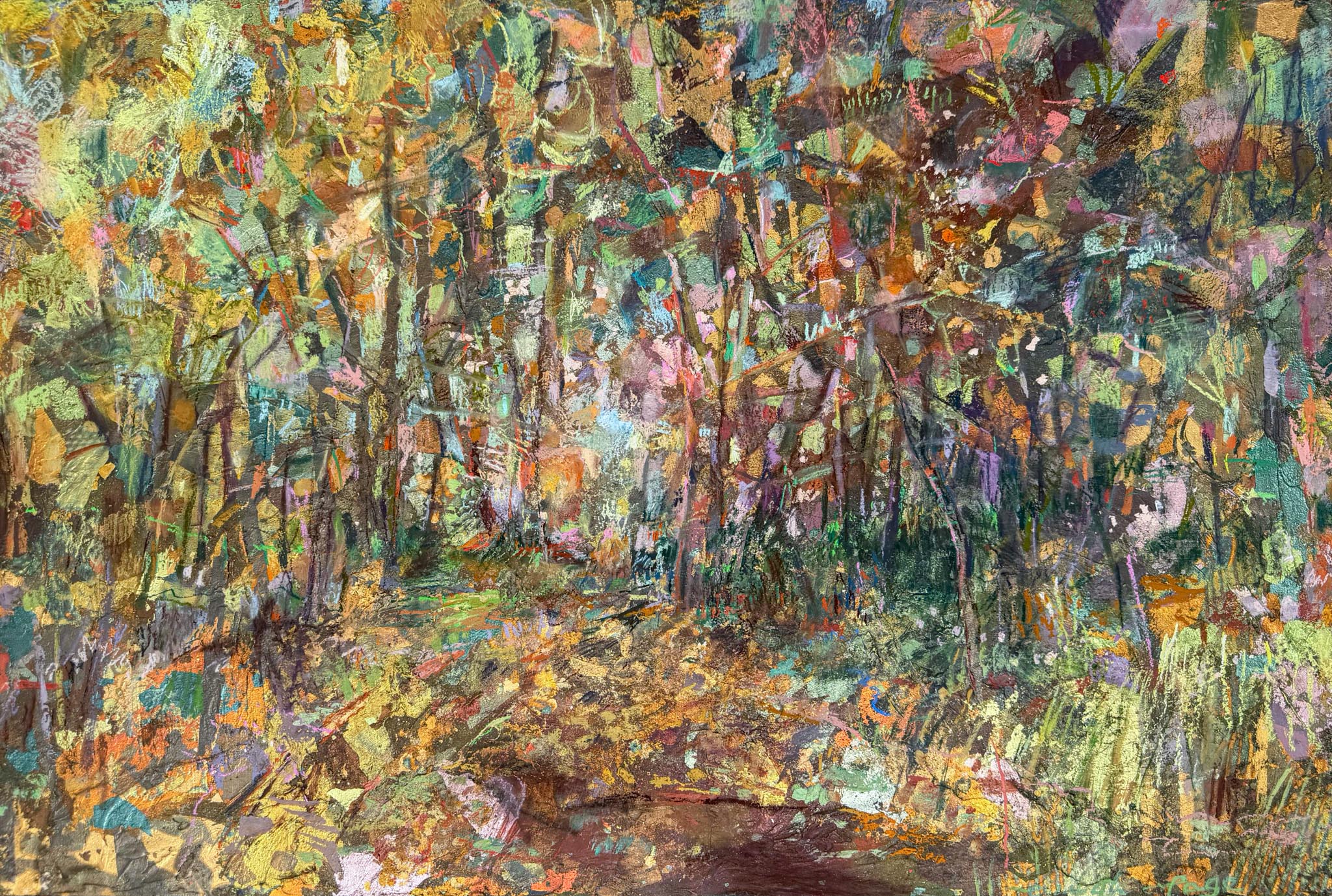
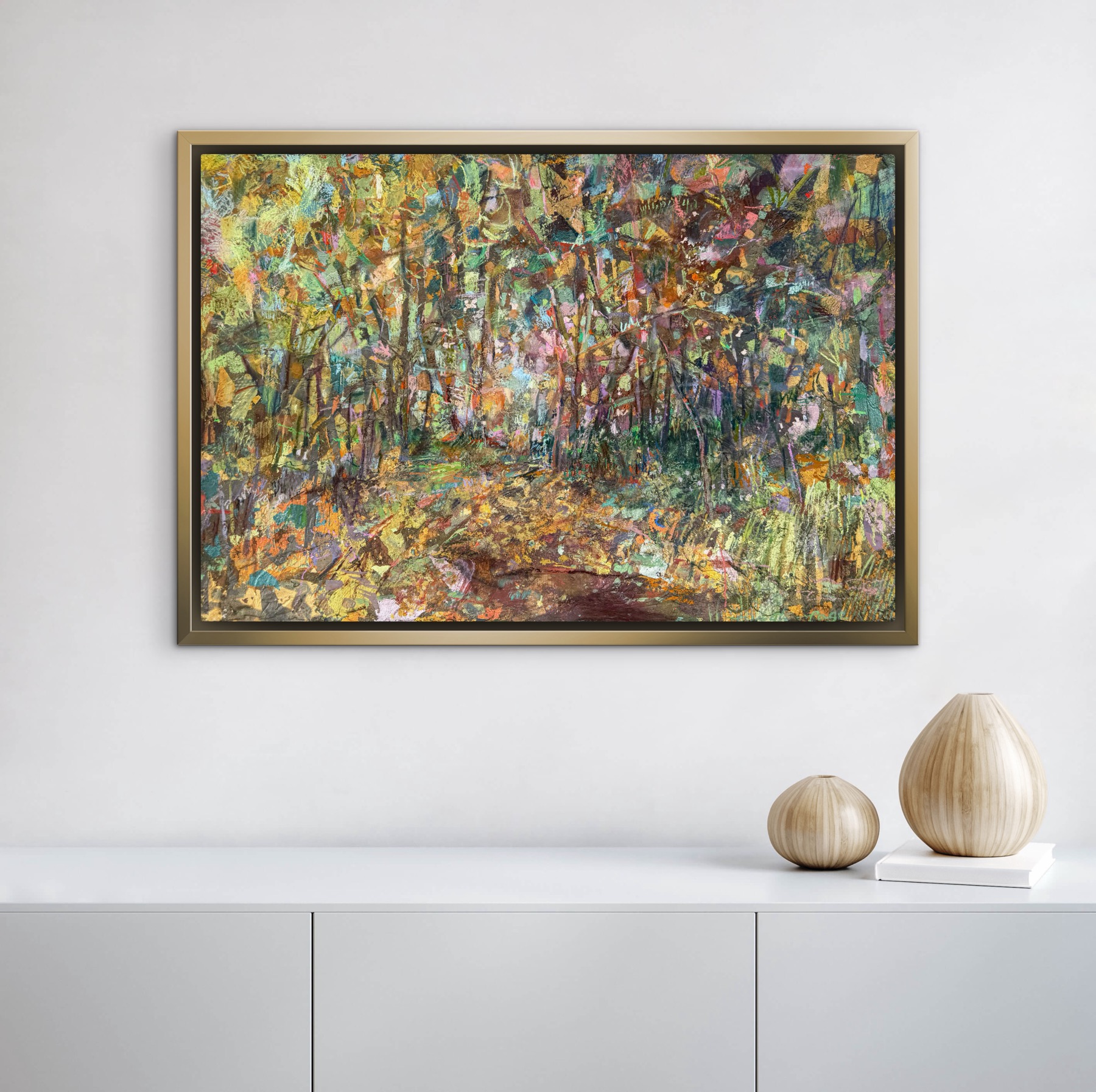
Field of Trees (previously titled Forest of Seeds) began with a desire to capture the moment that exemplifies the abundance of nature — if we were able to see everything all at once.
Looking through the crisscrossing branches of a sage plant, there are hundreds of stems branching again and again, carrying flowers, carrying seeds. The depth of that image feels almost infinite.
When the space is compressed and everything is included at once, the experience shifts. Instead of focusing on a single branch or form, you begin to feel the overwhelming density of life present within the plant.
The painting began by building texture across the panel — and then layering metal leaf over that texture, and then paint over textured leaf. It is the sensation of multiple depths, multiple images, existing together. As the painting developed, the image began to resemble a forest.
Later, another layer arrived — soft pastel, sitting on top of every layer that came before it. One more layer of depth added to the others, sharpening the image and bringing the forest into clearer focus. This is a continued study into the sensation of abundance and the shifting nature of our focus when confronted with so much to see at once.
Hidden From Itself
This piece began with a black gesso ground layered with acrylic paint and gold leaf. Over that, a layer of silk — a material traditionally used in some Japanese painting practices — creates an semi-translucent encaustic-like base to paint on top of. Oil paint applied with spatula and brush sink the paint into the silk, while oil stick sits on top in thick, crusty, gestural marks. Finally, layers of gilded wool and paper are layered on top, creating actual surface texture, light-catching shine, and irregular topography.
Originally titled “The Ecosystem of the Plant” I was after was the feeling of looking into a thick shrub like looking into infinity- the way your eyes move between focus and unfocus while looking through layers of leaves, stems, seeds, and shadow. There is a density inside a bush that can feel endless, like an entire world contained within itself.
Embedded leaves and gold leaf behind the silk, combined with layers of thick oil stick lines and marks, and textured gilded wool, built a space that feels almost infinite, as though the image continues deeper into the panel. Something (creation, our own evolution) is happening all the time, and it remains often hidden from our own eyes.
The work has also started opening toward an installation idea — what it would mean to physically enter the microclimate of a sage bush and experience its density and layered complexity from within.
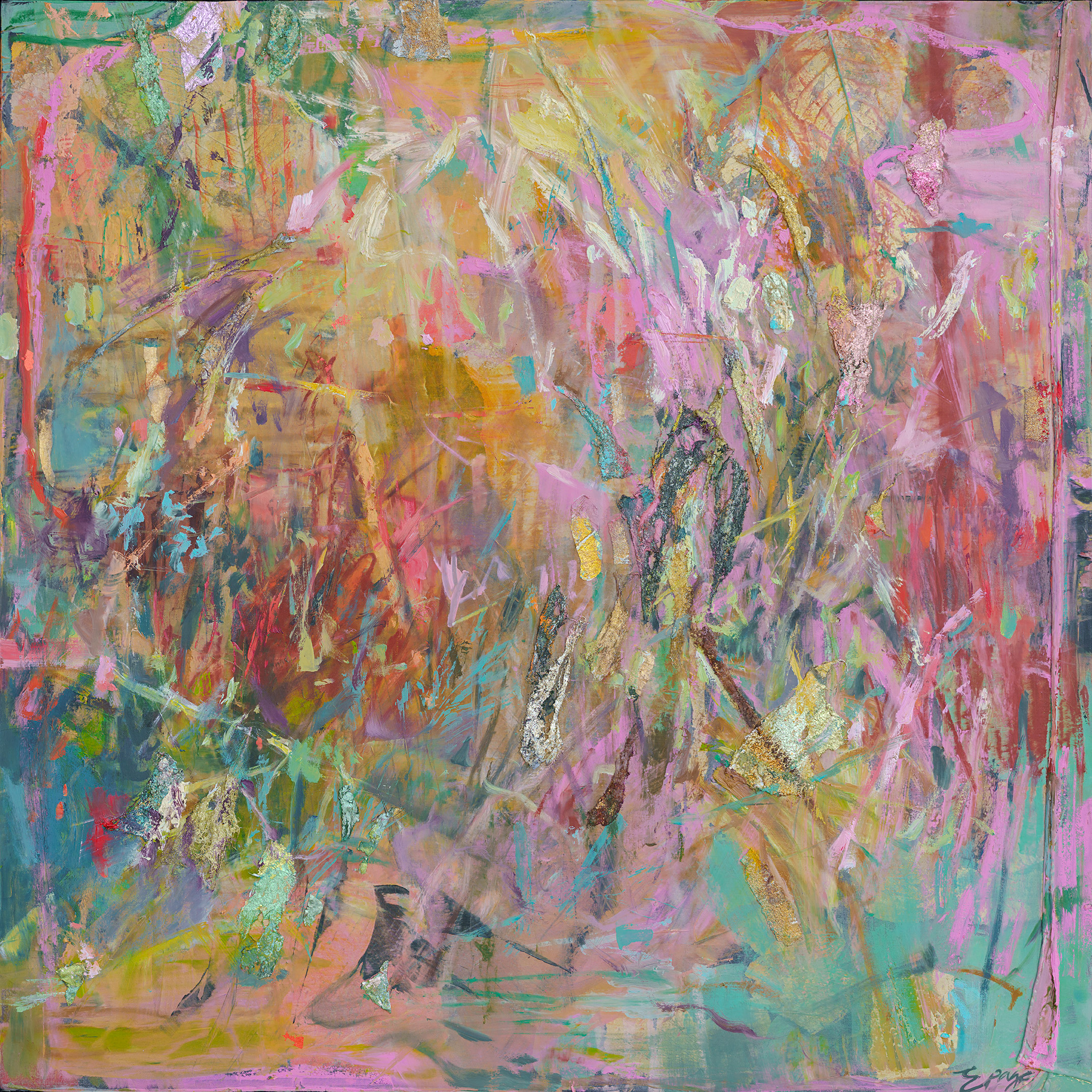

Field of Seeds (flowers)
Field of Seeds began with collecting. I gathered seeds with my son, crushing them into my hands and placing them into a bowl. Compost found its way into the mixture as well —thanks to him— eggshells, stems, branches, fragments of plants. All of it belonged.
The seeds, compost, plant material, and mulberry paper, were embedded directly into the panel surface, then layered with gold leaf, silver leaf, dyed silver, brass, and glass glitter. There is no paint in the work. The image emerges entirely through gilded organic matter and the subtle tonal shifts of metal leaf, texture and light built into the surface itself.
In its finished state, the piece feels ethereal. Suggestions of a field begin to appear, and flower-like forms emerge from the density. This is literally a field of seeds, compressed into an image.
The work feels tactile and asks to be touched — seeds want to be gathered, held, scattered, and seen. The installation ideas connected to this piece are moving toward something physical and immersive: an experience involving touch, accumulation, gathering, and dispersal. An environment that invites closeness and engagement with the earth.
%20hero.jpg)
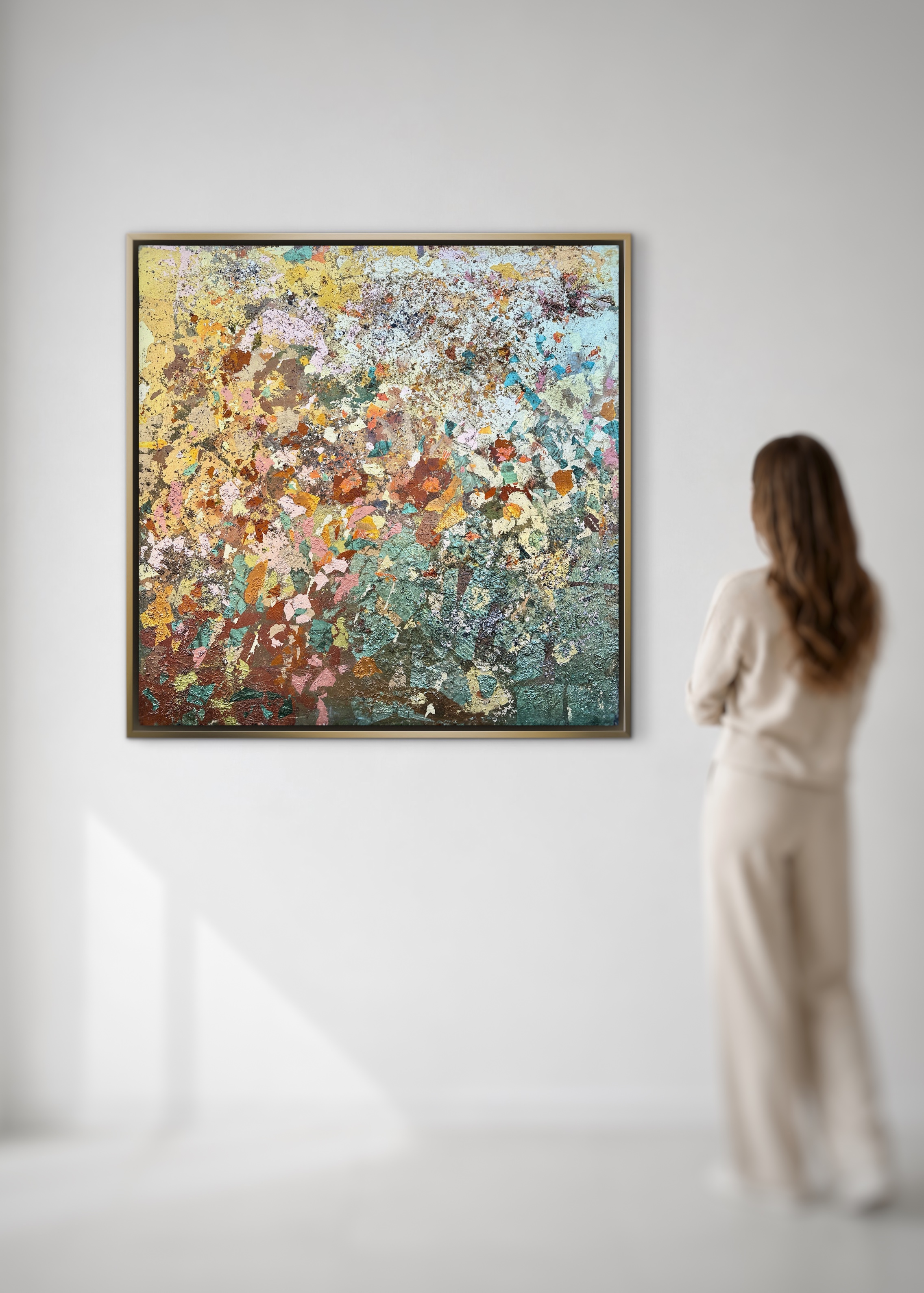
Harmonics (Life is a Wave Form)
Harmonics began alongside its sister piece, Flower Harmonies. Each one took a different view of what a base layer of gilded leaves could become.
For Harmonics I took leaves and branches from our jojoba plant and willow acacia tree, and pressed and dried them flat. I gathered fallen seed pods from palo verde and jojoba and scattered them across the panel surface along with leaves, and arranged the composition a bit — so what comes through is more the structure of branches and leaves. Paper was worked in a few places where the wood panel felt to bare. Then gold leaf and silver leaf over the top.
Five strips of green paper then torn and laid across the surface in a vertical orientation, then silk strips tinted to match. Gilded paper went down flat and shiny in some areas, while others areas of the piece stayed pitted and raised, so light catches differently. In places the silk sits so high over the ridge of a seed pod or branch there is actual space underneath it — you could put a finger under the surface.
Other pieces in this series have built density through thin layers carefully stacked and lit from within, more or less flat by comparison. Harmonics has actual relief — closer to sculpture, a first step toward something you could stand inside of.
The name comes from sound: a chord as several notes imprinted over each other, the same image turned seven ways. I wanted to create a visual experience of what is usually captured in sound—harmonics — and for the image to convey that life is volume, rhythm, silence, space, and charge -all at once. What does it look like to be regenerating?


Colliding Collapsing ReEmerging
This piece began alongside Harmonics. Soil, fallen seed pods and leaves covered the whole panel, sealed so they would harden, then gessoed and gilded with gold, silver and mixed metal leaf. It started as the desert floor in this season, after the palo verde and ironwood have dropped everything.
The gilded texture came out so dense and even that no image could come through. To find one, I kept layering: gilded paper, red paper, paper gilded with dyed red silver leaf, wool, dyed silk, paint. Smooth paper laid over the pitted surface sits higher, catches more light, and reads lighter. The darker, heavily textured areas fall into shadow. Forms rise in one place and sink in another.
The title is what resolved it. It wasn't the desert floor anymore. It was the cycle of life all happening at once: something emerging, something collapsing into shadow, something colliding.
There's so much motion that you either stand far back and take in the energy, or choose one area and stay there. Taken all at once, it's too much, and that's what I wanted to explore. It goes against a lot of formal ideas about composition, but it shows how hard it is to see everything that's happening, and how constantly our eyes are choosing what to focus on. The reds push that energy further. It's also one of the hardest pieces to photograph, because the surface keeps changing with the light.
While making it, I found myself thinking of Matisse's red room and Monet's chrysanthemums. It wasn't their style, but certain gestures and colors. That sense of reaching into a shared creative current is part of this piece's story. Circle members can hear more about it in the Studio Feed.
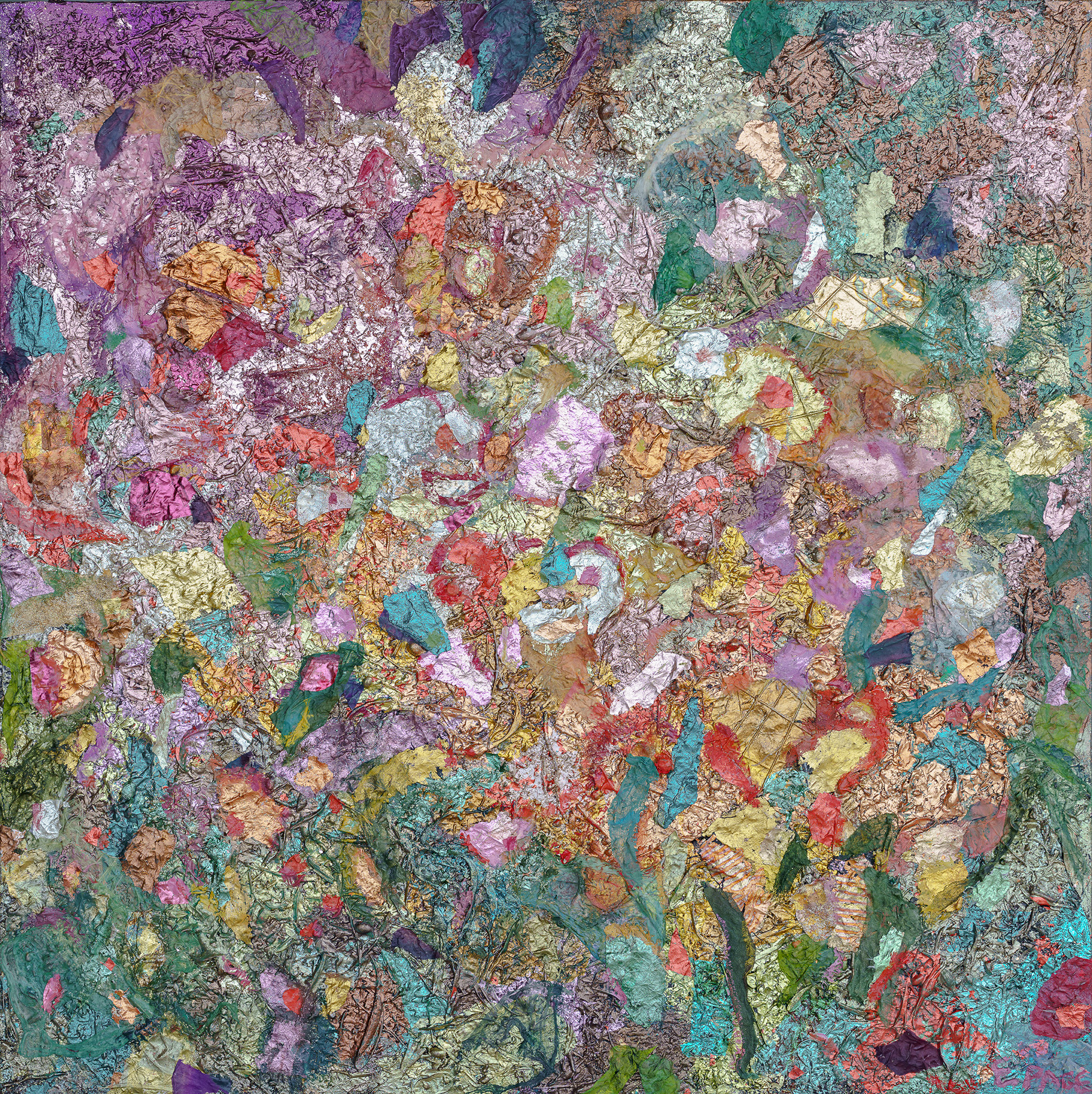
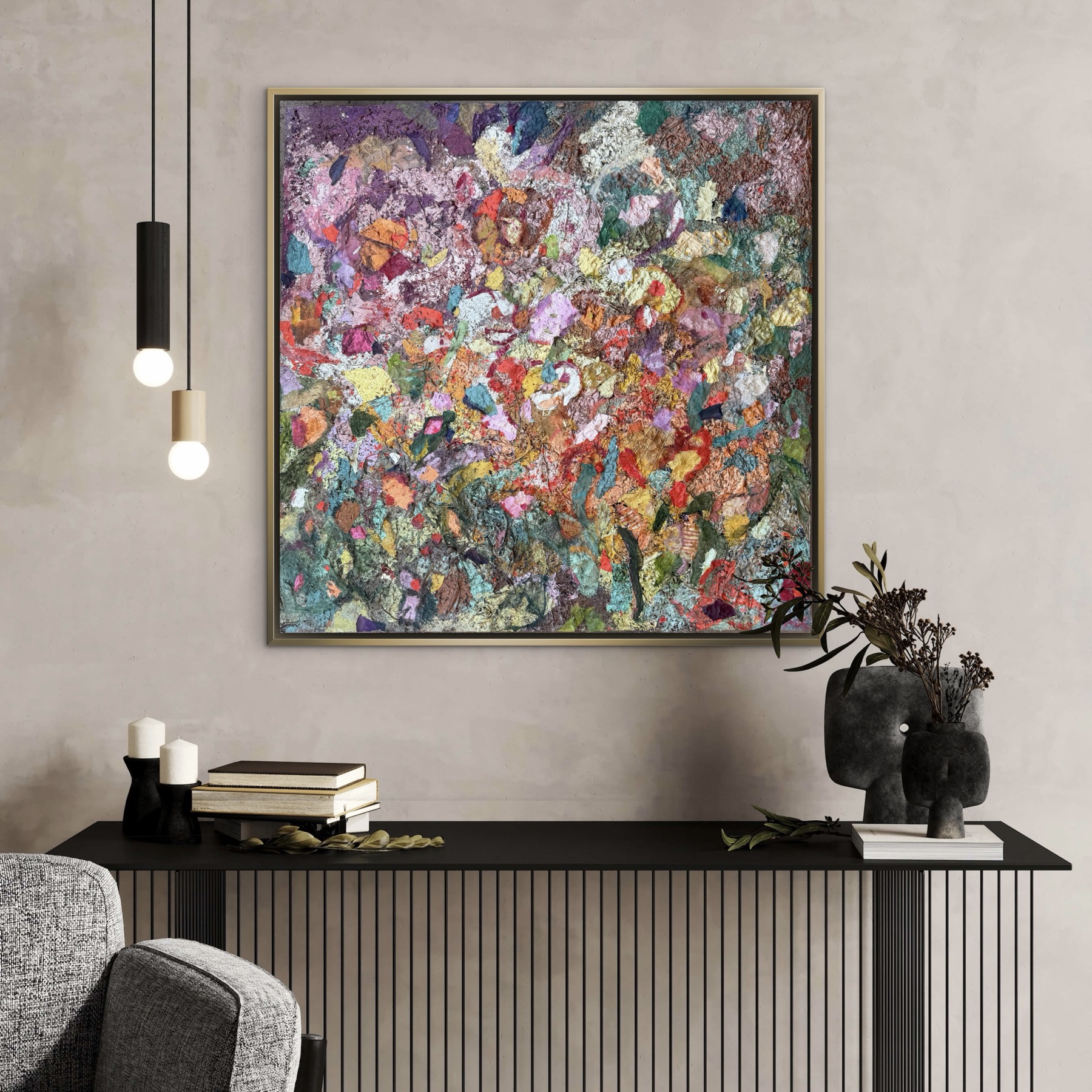
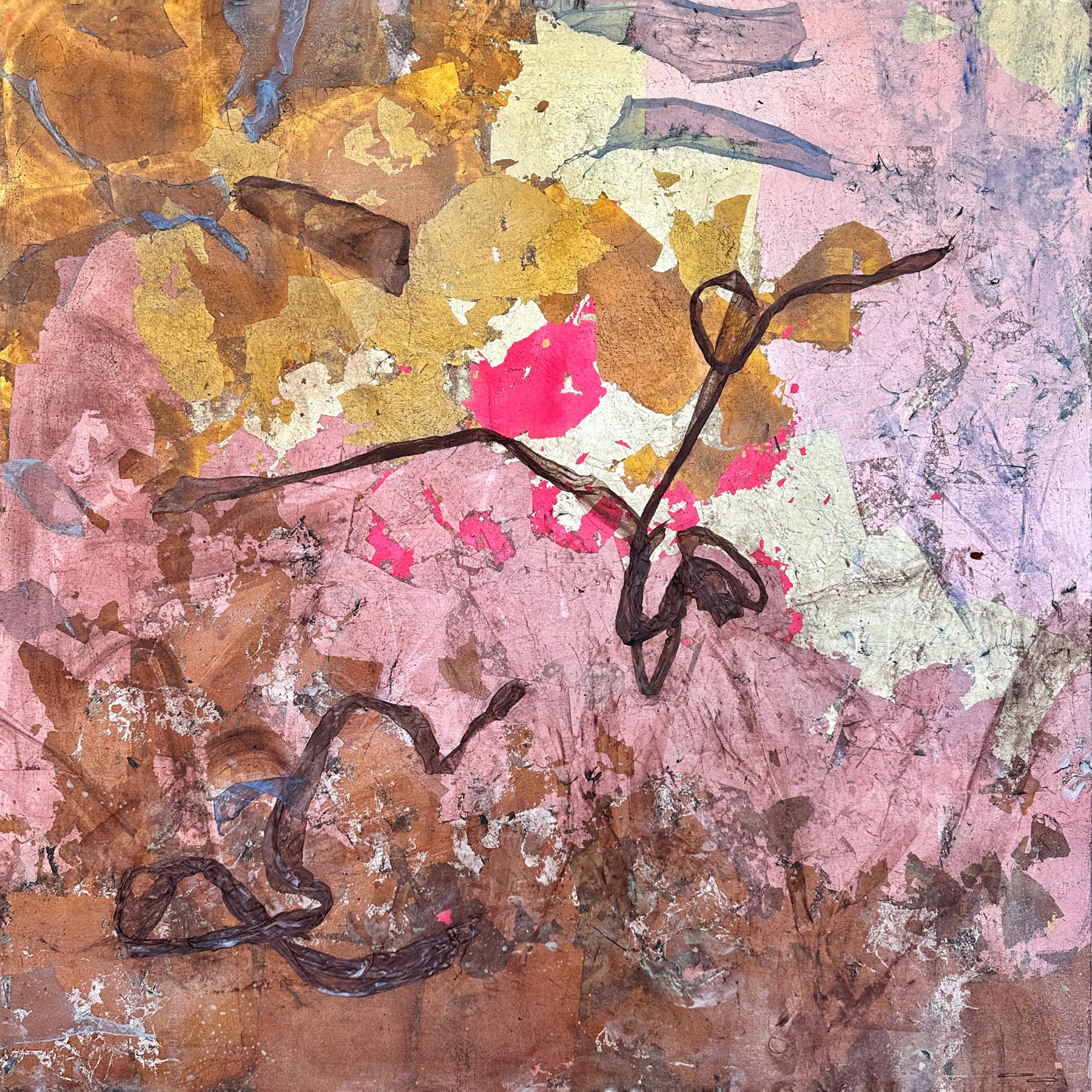
Seed Pod no. 4
Seed Pod No. 4 began with branches.
The installation ideas have been moving toward the experience of standing under a tree — watching the carpet of fallen flowers on the ground, feeling the shadows of branches shift across your feet in the sunlight. This piece is playing with those shapes and that quality of translucency.
There is a base of gold, silver, and dyed silver leaf, with a layer of very fine silk chiffon laid over it -- thin enough that the leaf shows through. Pieces of silk dyed with earth pigment were then layered on top, playing with translucency further. Where the silk doubles at the edges it darkens, reading almost like branch and twig forms. A swatch of blue silk laid over both pink and blonde silver leaf creates something that might be a flower, or a mountain developing in the distance.
The investigation is beginning to zoom out. The earlier pieces were concerned with the singularity of seeds — their scale, their texture, their abundance. This one is moving toward the interconnected ecosystem they belong to: branches, shadows, the passage of light through layers, the way you can look at a tree and never quite arrive at a single fixed thing.
This piece is still in process.
From Surface to Space
The seed pod paintings all consider the experience of compressing depth into a single plane to emphasize abundance. Seeds. Soil. Fragments of organic life. Silk. Cast leaves. Light. Multiple layers existing at once — the same way countless seeds, branches, flowers, plants, sky, insects, atmosphere, exist simultaneously within a single square foot of landscape.
The installation vision unfolds that compressed field of the canvas back into space.
Seed pods expand beyond their natural scale.
Seeds drift through the air and gather across the ground.
Strings of flowers floating through the air.
Shadows of branches shifting across the floor as visitors move through the space- — so that the body begins to register what the eye has been missing. Sound. Touch. Changing scale. Rooms that give different perceptual experiences of the same abundance.
What begins as observation gradually becomes immersion.
The exhibition ultimately leads visitors outside — a quiet place to sit, lie beneath the trees, look upward through the branches.
The intention is not to recreate nature. It is to restore attention.
To recognize the overwhelming abundance that was always present.
Participation
For Collectors
Collectors interested in acquiring available works from these investigations are welcome to inquire.
FOR CURATORS, INSTITUTIONS, AND COLLABORATING ARTISTS
These investigations are evolving toward large-scale installation environments.